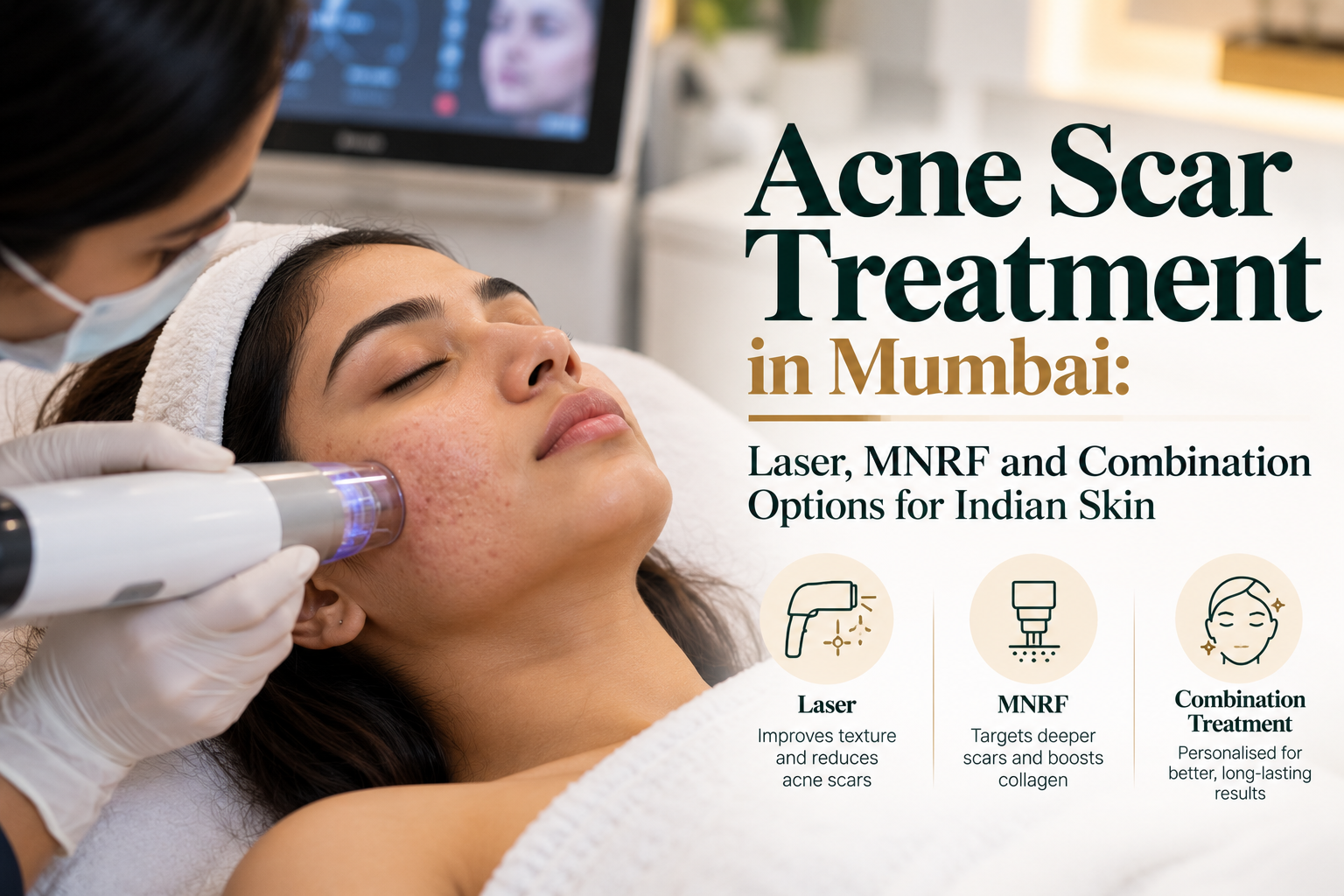
Someone told you to get “a laser” for your acne scars. Before you book, ask which scars. A pit, a dent, a raised lump and a dark mark are four different problems, and each needs its own fix. Get it wrong and you can spend months waiting for a result that was never going to show up.
This guide covers acne scar treatment in Mumbai: the types of scars, why acne scar treatment for Indian skin nes extra caedre, how lasers compare with MNRF treatment for acne scars, and what it costs in Navi Mumbai.
Types of acne scars
Icepick scars look like tiny punctures. They’re narrow, deep and the hardest to shift. Boxcar scars are wider dents with sharp edges, usually on the cheeks and temples. Rolling scars are shallow waves, where tissue underneath tugs the skin down. Most people have a mix of all three.
Raised scars, meaning keloids and hypertrophic scars, sit above the skin. They usually need steroid injections or something similar, and resurfacing can make them worse.
Then there are the flat brown or red marks a pimple leaves behind. Those aren’t scars. They’re pigmentation, and they often fade with time, sunscreen and the right creams. Paying for a laser to treat them is usually money wasted.
Acne scar treatment for Indian skin: why it needs extra care
Indian skin makes more melanin, and melanin reacts badly to injury. Heat or wound the skin too hard and you can get dark patches, called post-inflammatory hyperpigmentation. They can hang around for months and sometimes look worse than the scar you came in with.
Lasers aren’t off the table. But the doctor matters more than the machine. Someone who treats Indian skin every day will test a small patch, start gently and build up. If a clinic goes straight to the strongest setting on your first visit, leave.
Laser options
Fractional CO2 is the strongest of the common lasers. It drills tiny columns into the skin, and the body answers by making new collagen. It works well on boxcar and deeper scars. The catch is the longest recovery and the highest pigment risk on darker skin.
Fractional Er:YAG works the same way but is usually milder. Non-ablative fractional lasers warm the deeper skin and leave the surface alone. Recovery is quick, but results are gentler and you need more sessions.
On Indian skin, a gentler laser used several times usually beats one aggressive session.
MNRF treatment for acne scars
MNRF is microneedling with radiofrequency. Fine needles go into the skin and release radiofrequency energy deep down. Many of the needles are insulated, so the surface takes less damage than it would with an ablative laser.
That’s why a lot of dermatologists reach for it on darker skin. It builds collagen, firms the skin a little and softens shallow to moderate scars, with a lower pigment risk. You’ll have a few days of redness and tiny pinpoint marks. It works well on rolling and boxcar scars. Deep icepick scars usually need something extra.
Combination approaches
Real faces have mixed scars, so real plans mix tools. Subcision uses a needle to free rolling scars that are tethered from below. TCA CROSS puts a strong acid into icepick scars, and it’s cheap and works better than you’d expect. Laser or MNRF then smooths the overall texture, and peels and creams handle the dark marks.
A good clinic can tell you what each step is for. If one machine is the answer to every scar, ask why.
Sessions, downtime and results
Count on 3 to 6 sessions, roughly 4 to 6 weeks apart. Severe scarring takes more. Collagen is slow, so you may notice something by session two or three, and skin keeps improving for months afterwards.
Downtime depends on the treatment. MNRF usually means 1 to 3 days of redness. Fractional CO2 can mean a week or more of redness, peeling and sensitivity. Non-ablative lasers are often 1 to 3 days. Wear sunscreen throughout.
Expect better skin, not scar-free skin. Shallow scars improve more, and deep icepick scars improve least. Anyone promising flawless skin is selling.
Acne scar treatment cost in Navi Mumbai
Clinics price very differently, so treat these as rough ballparks and get quotes in writing. A fractional laser session often costs around ₹5,000 to ₹15,000. MNRF is often around ₹8,000 to ₹25,000. TCA CROSS and subcision usually cost less per session. [Add your clinic’s real price list here.]
The price depends on the device, the area, the number of sessions and the doctor’s experience. Packages can bring the cost per session down, but check what happens if you need extra sessions. If one clinic is far cheaper than the rest, ask what machine they use, what settings, and who actually does the treatment.
Book a consultation
Book a consultation, not a package. A good dermatologist looks at your scars, checks your skin tone and history, tests a small patch and gives you a realistic plan, including what won’t improve.
If you’re considering acne scar treatment in Mumbai, you can book at My Aesthetic Plus, MGM Medical College, Plot 46, Sector 30 A, Vashi, Navi Mumbai 400703. We’re open 10 AM to 8 PM, Monday to Saturday, on 7977778451.
FAQs
Which treatment works for acne scars on Indian skin?
There’s no single answer. A mix usually works: MNRF or a gentle fractional laser for texture, subcision for rolling scars and TCA CROSS for icepick scars.
How much does acne scar treatment cost in Navi Mumbai?
Often around ₹5,000 to ₹25,000 per session, depending on the treatment and clinic. A full course can reach a few tens of thousands. Ask what’s included.
Is laser treatment safe for dark skin?
Yes, with the right device, careful settings and a patch test, by someone who treats Indian skin regularly. Poor technique risks dark patches and burns.
Can acne scars be completely removed?
Rarely. Most treatments improve scars noticeably but don’t erase them.
This is general information, not medical advice. Results and costs differ for each person, so see a qualified dermatologist before starting treatment.