What Is Breast Augmentation?
Breast augmentation (augmentation mammoplasty) is an aesthetic and reconstructive surgical procedure that alters the volume, projection, and shape of the breasts. Volume enhancement is achieved using cohesive silicone gel implants or autologous fat transfer (fat grafting).
Common clinical indications include:
- Post-Pregnancy and Lactational Involution: Gestation and nursing stretch the overlying skin envelope while shrinking glandular breast tissue, often depleting upper-pole fullness.
- Developmental Hypoplasia: Naturally petite breast tissue that an individual feels is disproportionate to her shoulder breadth and hip dimensions.
- Congenital Asymmetry: Noticeable volume, height, or positional differences between breasts that make bra fitting and clothing difficult.
- Tissue Depletion After Weight Loss: Loss of thoracic subcutaneous fat deposits following weight reduction, resulting in tissue laxity and flattened contours.
Achieving a natural aesthetic requires respecting your underlying musculoskeletal anatomy. An aesthetic surgeon measures your base chest width, soft-tissue pinch thickness, parenchymal volume, and skin envelope laxity. An implant profile suitable for a wide, athletic torso can cause visible implant margins, tissue thinning, or traction rippling on a narrow ribcage.
Surgical Options: Implants vs. Fat Transfer
Patients considering breast implants in Navi Mumbai generally choose between silicone gel prostheses and autologous fat grafting.
1. Silicone Gel Breast Implants
Modern silicone implants contain cohesive silicone gel (often termed “gummy bear” implants). The silicone molecules are internally cross-linked, allowing the gel to maintain structural shape even under compressive stress.
- Cohesive Gel and Rupture Nuances: Cohesive silicone significantly reduces the rate and migration velocity of free silicone fluid compared to liquid silicone implants of previous decades. However, cohesive implants are not indestructible. An implant shell tear can still result in an intracapsular rupture (contained within the surrounding fibrous scar capsule) or an extracapsular rupture (extruding outside the capsule into breast parenchyma or regional lymph nodes).
- Round Implants: Deliver uniform projection across upper and lower breast quadrants. They provide noticeable upper-pole cleavage definition and structural fullness, making them well-suited for post-nursing upper-pole depletion.
- Anatomical (Teardrop) Implants: Feature a gradual slope from top to bottom, mimicking the natural profile of an untouched breast. They are often selected for lean individuals with minimal baseline breast tissue, though they carry a small risk of implant rotation that requires precise surgical pocket dissection.
2. Autologous Fat Transfer (Natural Breast Enlargement)
Fat transfer uses gentle liposuction to harvest adipose tissue from donor sites, such as the abdomen, flanks, or thighs. The harvested fat is filtered, decanted, or centrifuged before being injected in micro-droplets throughout the subcutaneous and parenchymal tissue planes.
- Volume Limitations: Fat transfer is ideal for modest enhancement (typically a 0.5 to 1 cup size increase) or to soften visible implant margins in thin patients (hybrid breast augmentation).
- Retention Variability: A variable portion of transferred fat is naturally reabsorbed as local tissues establish new vascularity. Retention rates depend heavily on harvesting techniques, recipient site vascularity, and individual metabolism. Surviving fat cells remain permanently and fluctuate with future weight changes.
- Diagnostic Considerations: Fat grafting can occasionally lead to oil cysts or benign fat necrosis calcifications, which require documentation so that radiologists can distinguish them from suspicious microcalcifications on future mammograms.
Comparison of Augmentation Techniques
| Surgical Parameter | Cohesive Silicone Implants | Autologous Fat Grafting |
| Material Used | Medical-grade cross-linked silicone gel | Purified autologous patient fat |
| Volume Potential | Predictable; 1 to 2+ cup size increases | Modest; typically 0.5 to 1 cup size |
| Incision Size | 3.5 cm to 5 cm hidden incision | Tiny cannula puncture sites (under 4 mm) |
| Device Longevity | Not lifetime devices (typically 10 to 15+ years) | Surviving fat cells remain permanently |
| Weight Changes | Implant volume remains stable | Grafted volume expands or shrinks with weight |
| Diagnostic Follow-up | Ultrasound or MRI screening for silent rupture | Standard mammograms with radiologist notification |
Surgical Placement Planes and Incisions
Placement Planes
- Dual-Plane (Partial Submuscular): The upper portion of the implant is placed under the pectoralis major muscle, while the lower pole is covered by natural glandular tissue. This dual arrangement cushions the upper edge, smoothing transitions in thin patients and lowering the historic rate of capsular contracture. Trade-offs include initial muscular soreness and potential animation movement (subtle implant displacement during hard pectoral flexing).
- Subglandular: The implant is positioned between the breast gland and the pectoral muscle fascia. It eliminates muscle dissection and animation movement, but requires sufficient natural breast tissue (typically a pinch test greater than 2 cm) to conceal implant edges.
- Subfascial: The implant sits beneath the deep pectoral muscle fascia over the chest muscle, serving as an intermediate option for selected candidates.
Incision Locations
- Inframammary Fold (IMF): Placed in the crease under the breast. This is the most common technique because it provides direct visibility for pocket dissection, minimizes glandular trauma, and places the scar in the breast’s natural shadow.
- Periareolar: Placed along the lower semi-circle border of the areola. Useful when a minor skin lift (mastopexy) is performed concurrently, but carries a slightly higher risk of ductal contamination and temporary changes in nipple sensation.
- Transaxillary: Placed in the armpit crease, leaving no scars on the breast. This approach requires specialized endoscopic instruments and makes secondary pocket revisions more complex.
The Surgical Procedure Step-by-Step
A standard breast enlargement procedure at an accredited surgical hospital involves structured clinical steps:
- Pre-Operative Markings: While you stand upright, your surgeon marks your chest midline, breast meridian, and inframammary fold position to guide pocket symmetry.
- Anesthesia Administration: The procedure is performed under general anesthesia with real-time hemodynamic monitoring by a consultant anesthesiologist.
- Pocket Dissection: The surgeon creates the surgical pocket under direct visualization with careful hemostasis to prevent post-operative hematoma.
- No-Touch Implant Insertion: The pocket is irrigated with specialized antibiotic solutions. Most surgeons use single-use insertion sleeves (such as a Keller Funnel) to minimize skin-to-implant contact and lower infection risks.
- Layered Closure: The incision is closed in tension-free anatomical layers using absorbable sutures. Sterile dressings and an engineered surgical compression bra are fitted immediately.
- Duration & Discharge: Primary implant augmentation typically takes 1 to 2 hours depending on anatomy and technique. Concurrent procedures, such as a breast lift (mastopexy) or fat grafting, extend operative time. Discharge generally occurs either the same evening or following overnight observation.
Breast Augmentation Recovery: Clinical Milestones
Breast augmentation recovery varies based on your tissue healing, the placement plane chosen, and whether concurrent procedures were performed.
Days 1 to 3: Immediate Post-Operative Stage
- Expect chest wall tightness, swelling, and moderate discomfort, especially with submuscular pockets.
- Discomfort is managed with prescribed oral pain relievers, anti-inflammatories, and antibiotics.
- Rest in a semi-reclined position (elevated 30° to 45°) to reduce tissue edema.
- Take gentle indoor walks to encourage venous circulation and prevent blood clots.
Days 4 to 7: Early Healing Stage
- Acute muscle soreness decreases, and initial tissue swelling begins to plateau.
- Most patients working sedentary or desk jobs can plan a return to light work, provided it involves no overhead reaching or heavy lifting.
- Do not drive while taking prescription pain medications.
Weeks 2 to 3: Intermediate Healing Stage
- Incision lines seal and bruising fades.
- Non-strenuous daily activities and routine errands can resume.
- Driving is permissible once pain medications are stopped and upper-body range of motion is comfortable.
Weeks 4 to 6: Tissue Softening Stage
- The pectoral muscle relaxes, allowing implants to descend naturally into the lower pole pocket (the “drop and fluff” phase).
- Light lower-body cardio (such as stationary cycling or incline treadmill walking) can be resumed after clinical clearance from your surgeon.
- Continue wearing your prescribed compression bra as instructed.
Beyond Week 6: Long-Term Stabilization Stage
- Internal capsular tissue stabilizes.
- Clearance for high-impact workouts, heavy upper-body weightlifting, jogging, and swimming is evaluated during follow-up visits.
- Patients can usually begin shopping for standard non-wired or underwire bras.
Clinical Recovery Note: Always follow the post-operative protocol provided by your operating surgeon. Do not adopt unverified movement bans or discontinue your surgical support bra early without clinical clearance.
Breast Augmentation Cost at My Aesthetic Plus (Navi Mumbai)
At My Aesthetic Plus, procedure fees are determined following an in-person anatomical evaluation. Because breast augmentation is customized to each individual’s tissue characteristics, a generic flat rate is not clinically viable.
Key Factors Determining Your Treatment Cost:
- Implant Selection & Technology: Internationally certified, US FDA-approved or CE-marked cohesive silicone implants (such as Mentor or Motiva) involve distinct manufacturer charges and warranty protections.
- Surgical Technique: Primary silicone placement, autologous fat grafting, or hybrid augmentation (combining implants with fat transfer) require different surgical times, instrumentation, and theater resources.
- Hospital & Theater Infrastructure: Operations are conducted at MGM Medical College (Sector 30A, Vashi), providing advanced surgical theater sterility, laminar airflow, and round-the-clock emergency medical backup.
- Anesthesia & Specialist Care: Complete coverage for dedicated consultant anesthesiologists and specialized post-anesthesia recovery monitoring.
- Combined Corrections: If breast tissue exhibits laxity or ptosis, combining the enlargement with a breast lift (mastopexy) adjusts the operative time and theater fees.
Transparent Pricing Policy: During your initial consultation at our Vashi clinic, you receive a detailed, personalized breakdown outlining surgeon fees, implant device costs, hospital theater charges, anesthesia, post-surgical garments, and follow-up reviews to ensure full clarity with no hidden fees.
Essential Patient Safety & Long-Term Considerations
Under medical ethics and informed consent standards, every patient should understand potential long-term device considerations before surgery:
1. Implants Are Not Lifetime Devices
Breast implants are not lifetime prostheses. While modern cohesive devices can remain intact for 10 to 15 years or longer, the lifetime risk of local complications increases over time. A proportion of patients will eventually undergo secondary revision surgery for implant exchange, pocket repositioning, or removal.
2. Silent Rupture Screening (FDA Recommendations)
Silicone implant shell failures are often “silent,” meaning they cause no pain, shape change, or palpable symptoms. The US FDA recommends initial screening for silent rupture using high-resolution ultrasound or MRI at 5 to 6 years post-implantation, followed by regular imaging every 2 to 3 years thereafter.
3. Capsular Contracture
Your immune system forms a natural collagen capsule around any implanted medical device. In a subset of patients, this capsule abnormally thickens and tightens (graded as Baker Grades III or IV), causing firmness, shape distortion, or localized pain. Severe contracture requires surgical capsulectomy and implant exchange.
4. Sensation and Breastfeeding
Most women with submuscular implants placed through inframammary fold incisions can breastfeed successfully. However, surgery carries potential risks of temporary or permanent changes in nipple-areolar sensation (hypoesthesia or hyperesthesia) and possible reduction in milk volume if glandular tissue or nerve branches are affected.
5. Rare Conditions & Systemic Symptoms
- BIA-ALCL (Breast Implant-Associated Anaplastic Large Cell Lymphoma): A rare, treatable malignancy of the immune system that develops in the scar capsule surrounding breast implants, historically associated primarily with macro-textured implant surfaces. Symptoms typically present years after surgery as sudden, persistent fluid accumulation (late seroma) or an unexplained mass.
- BIA-SCC: An extremely rare squamous cell carcinoma identified in the fibrous capsule surrounding breast implants.
- Breast Implant Illness (BII): A term used by patients to describe a spectrum of systemic symptoms (such as chronic fatigue, cognitive issues, joint pain, and skin rashes). While clear diagnostic biomarkers are still being studied, plastic surgery societies take these patient reports seriously; surgical removal of the implants and capsules often leads to symptom improvement.
6. Cancer Screening Compatibility
Breast implants do not increase your risk of developing primary breast cancer. During routine mammograms, inform your radiographer that you have breast implants. They will perform specialized displacement views (Eklund views) to move the implants backward toward the chest wall, ensuring surrounding natural breast tissue remains visible.
Selecting a Breast Augmentation Surgeon in Navi Mumbai
The safety and aesthetic outcome of your procedure depend on the qualifications of your surgical team. When selecting a breast augmentation surgeon in Navi Mumbai:
- Board Certification in Plastic Surgery: Verify that your surgeon holds an MCh or DNB in Plastic and Reconstructive Surgery recognized by the National Medical Commission (NMC). General surgeons, dermatologists, or practitioners using generic cosmetic labels without plastic surgery super-specialty degrees lack formal multi-year residency training in aesthetic breast architecture.
- Operating Room Infrastructure: Confirm that your surgery will take place in an operating theater equipped with laminar airflow, advanced emergency life-support equipment, and 24/7 critical care backup.
- Documented Clinical Results: Review unedited photographic portfolios of previous patients who started with anatomical baseline characteristics similar to yours.
Frequently Asked Questions
Will breast enlargement surgery prevent me from breastfeeding in the future? Many women breastfeed successfully following breast augmentation. Placing the implant beneath the pectoral muscle through an inframammary fold incision preserves the main milk ducts and neurovascular supply. However, no surgical approach can guarantee zero impact on milk volume or nerve sensation. Discuss your future family planning during your consultation.
How often should I have my breast implants checked? An annual clinical breast examination with your plastic surgeon is recommended. For silicone gel devices, the US FDA advises baseline screening for silent rupture using high-resolution ultrasound or MRI at 5 to 6 years post-surgery, repeated every 2 to 3 years thereafter, or whenever you notice localized pain, trauma, or contour changes.
Can breast implants cause autoimmune disease or cancer? Breast implants do not cause breast cancer. However, patients should understand BIA-ALCL, a rare lymphoma of the immune system linked to implant capsules (predominantly textured devices). Any unexplained late swelling, fluid accumulation, or breast lumps require prompt clinical assessment. Systemic symptoms (commonly referenced as Breast Implant Illness) continue to be evaluated through international clinical registries.
What happens during an initial consultation at My Aesthetic Plus? During an evaluation at My Aesthetic Plus, you undergo a clinical anatomical assessment including chest wall symmetry, breast base width, soft-tissue pinch thickness, and skin elasticity. Your surgeon discusses appropriate placement planes, reviews implant profiles, outlines safety protocols, and develops an individualized surgical plan.
Consultation & Next Steps
A balanced, long-lasting aesthetic result relies on sound surgical science, thorough patient education, and realistic expectations. If you are considering breast enlargement surgery in Navi Mumbai, schedule a private, in-person clinical evaluation with a board-certified plastic surgeon.
To discuss your goals and review anatomical options, arrange a consultation through My Aesthetic Plus or explore our clinical services for
Authoritative Medical References
- U.S. Food and Drug Administration (FDA): What to Know About Breast Implants & Regulatory Guidance on Breast Implant Safety and Labeling. Available at: https://www.fda.gov/medical-devices/implants-and-prosthetics/breast-implants
- American Society of Plastic Surgeons (ASPS): Breast Augmentation Surgery Procedures & Patient Safety Guidelines. Available at: https://www.plasticsurgery.org/cosmetic-procedures/breast-augmentation
- National Medical Commission (NMC), India: Medical Qualifications and Specialist Registry Regulations. Available at: https://www.nmc.org.in/
- FDA Medical Device Safety Action: Risks and Complications of Breast Implants (Including BIA-ALCL and Systemic Symptoms). Available at: https://www.fda.gov/consumers/consumer-updates/what-know-about-breast-implants
Medical Disclaimer: This article provides evidence-based medical education and is intended for general informational purposes only. It does not constitute medical advice, diagnosis, or a formal treatment plan. Surgical suitability, placement choices, implant selections, individual risks, and exact pricing can only be determined through an in-person clinical examination by a board-certified plastic surgeon.
Author:
Clinical Content Team, My Aesthetic Plus Medically Reviewed & Approved By: Dr. Aakanksha Kadam, MBBS, MS (General Surgery), MCh (Plastic and Reconstructive Surgery), Director and Aesthetic Plastic Surgeon at My Aesthetic Plus (Maharashtra Medical Council Registration No. 2012/03/0467). Disclaimer: This guide is published for patient education and informational purposes. Surgical planning requires an individualized in-person clinical assessment.
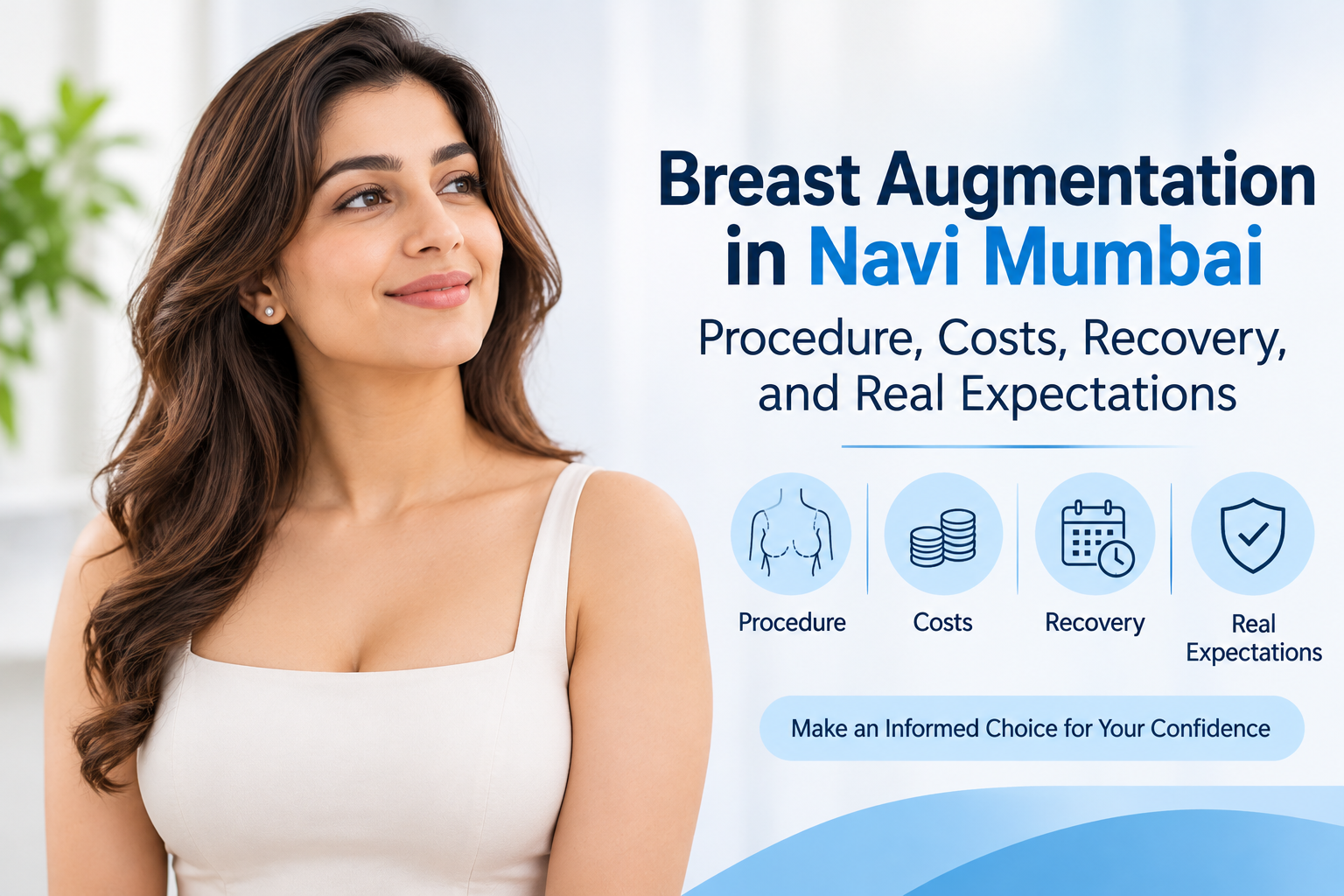
Navi Mumbai has matured into a premier center for tertiary healthcare and elective aesthetic surgery within the Mumbai Metropolitan Region (MMR). While patients across Vashi, Nerul, Belapur, and Kharghar once traveled across the creek to South Mumbai or the Western Suburbs, accredited operating theaters and super-specialist plastic surgeons are now practicing locally.
Among body contouring operations, breast augmentation in Navi Mumbai is one of the most frequently requested procedures. However, surgical objectives have evolved. Modern patients rarely ask for disproportionate or exaggerated sizes. Instead, the priority is anatomical balance: restoring fullness lost after childbirth and nursing, balancing congenital asymmetry, and achieving natural contours that move normally during daily activity.
If you are evaluating breast enlargement surgery, this clinical guide details your implant choices, surgical planes, recovery timeline, clinic pricing structure, and critical long-term safety protocols.